Garage Door Repair in Plano, TX: 911 Garage Door Repair Pros serves Plano and the surrounding area. Visit 911garagedoorrepairpros.com for a free quote.
TL;DR: Most noisy garage doors in Plano can be quieted with a $10 can of white lithium grease and 20–30 minutes of work. Squeaking usually means dry rollers or hinges; grinding points to worn steel rollers; rattling signals loose bolts. North Texas heat and humidity accelerate lubricant breakdown, so Plano homeowners should reapply every three months during summer. If you hear popping, loud banging from springs, or see cables fraying, stop and call a professional - those repairs carry serious safety risks.
Why Is Your Garage Door So Noisy? (Common Causes in Plano)
A noisy garage door is one of the most common complaints we hear from Plano homeowners, and the good news is that the fix is usually straightforward. (Weather.gov) Learn more about noisy garage door fixes in the Dallas area. The sound your door makes tells you exactly what's wrong - if you know how to listen.
Here in Plano, our summer temperatures regularly exceed 100°F, and that heat does real damage to garage door hardware. Metal expands, lubricants thin out and migrate off tracks within weeks, and rubber components harden faster than they would in cooler climates. This is why a door that ran quietly in spring might start squeaking by mid-July. The humidity in our North Texas summers compounds the problem, causing corrosion on steel rollers and accelerating wear on hinges.
The noise-to-cause map is straightforward:
| Noise Type | Most Likely Cause | DIY or Pro? | Urgency |
|---|---|---|---|
| Squeaking or squealing | Dry rollers, hinges, or springs | DIY (lubricate) | Low |
| Grinding | Worn steel rollers on track | DIY (replace) or Pro | Medium |
| Rattling or clanking | Loose bolts, brackets, or hinges | DIY (tighten) | Low to Medium |
| Banging or loud thud | Loose opener chain or unbalanced door | DIY (tighten) or Pro | Medium |
| Popping or cracking | Torsion spring tension issue | Pro only | High |
Squeaking is by far the most common - and the easiest to fix, as clarkandsonsdoors explains about noise causes. It means your rollers, hinges, and springs are moving without lubrication. Grinding usually indicates that your steel rollers have worn flat spots or are caked with debris. Rattling almost always points to loose hardware that a socket wrench can tighten in minutes. Banging often comes from a slack chain on your opener or a door that's lost its balance. Popping or cracking is the red flag: that's your torsion spring under abnormal tension, and it requires professional attention immediately.
How Do You Lubricate a Garage Door Step by Step?
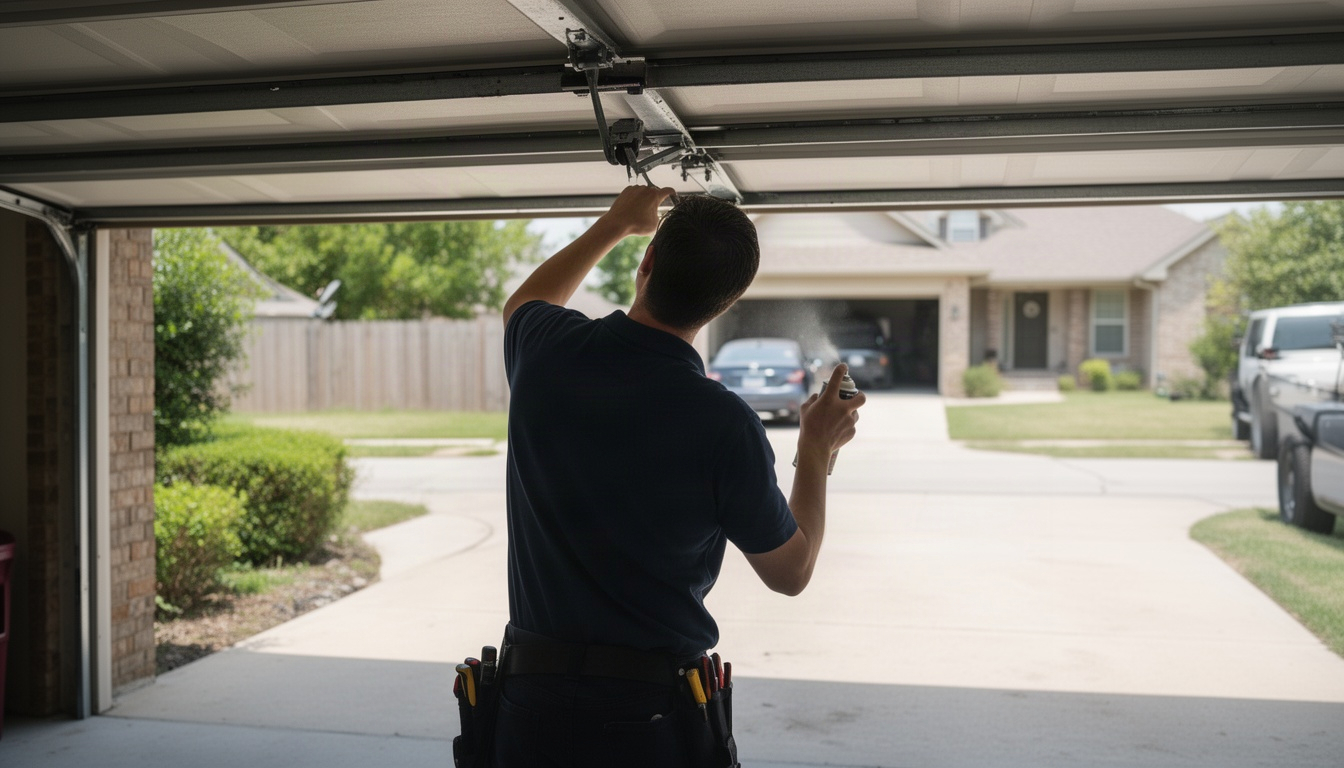
Lubrication is the most effective DIY fix for a noisy garage door, and it's genuinely simple. A single $10 can of white lithium grease or silicone-based spray can silence a squeaking door in under 30 minutes - no special tools required.
Why not WD-40? This is the question we get most often. WD-40 is a solvent and degreaser, not a lubricant. It evaporates quickly in our Plano heat and actually attracts dirt, which accelerates wear on the parts you're trying to protect. Stick with white lithium grease or a silicone-based garage door spray - both are designed to stay put and handle temperature swings.
Here's the step-by-step process:
- Clean the tracks first. Use a dry cloth or old rag to wipe out any dirt, debris, or old dried lubricant from the horizontal and vertical tracks. Don't use water - you want the tracks dry. This takes about five minutes and prevents dirt from getting ground into your rollers.
- Lubricate the hinges. Apply a light coat of white lithium grease to each hinge where the door panels connect. A standard double-wide door has 12–16 hinges. Don't oversaturate; a thin coat is all you need. Hinges are often the first place to squeak because they're constantly flexing.
- Lubricate the roller stems (not the wheels). This is critical: spray the metal stem where the roller connects to the bracket, not the nylon or steel wheel itself. If you have nylon rollers, they don't need lubrication - the sealed bearings inside handle that. If you have steel rollers, a light spray on the stem is enough.
- Lubricate the torsion spring coils. If your door has a torsion spring (the large spring running horizontally above the door), apply a thin coat of lubricant along the coils. This is especially important in Plano's heat, where springs can bind if they dry out.
- Lubricate the lock mechanism. If your door has a manual lock, a small spray here prevents sticking.
- Do NOT lubricate the tracks themselves. This is the mistake that causes more problems than it solves. Lubricant on the tracks traps dirt and causes the rollers to stick. Keep the tracks clean and dry.
- Do NOT lubricate the bottom seal or any plastic components. Oil-based lubricants degrade rubber and plastic over time, so avoid the weatherstripping at the bottom of the door.
Time estimate: 20–30 minutes for a complete lubrication. Cost: $6–$12 for a can of lubricant.
After you're done, open and close the door a few times to work the lubricant into the moving parts. You should hear an immediate difference. In Plano's summer heat, plan to repeat this process every three months - more often than the national standard - because our temperatures cause lubricants to thin and migrate off components faster than in cooler climates.
How to Fix Rattling, Grinding, and Banging Noises
Lubrication solves squeaking, but other noises require different fixes. Here's how to diagnose and address each one.
Rattling: Loose Hardware
Rattling is almost always caused by loose nuts, bolts, or brackets, as ndigaragedoors notes in their troubleshooting guide. See our guide to garage door spring replacement cost in Plano. Over time, vibration from the door opening and closing works these fasteners loose. The fix is straightforward: tighten them.
Use a 1/2-inch socket wrench to tighten the bolts on the door brackets, hinges, and track supports. See our guide to Garage Door Won't Close Plano TX. Work methodically around the door, checking every bolt. Don't overtighten - you can strip the holes and create new problems. Snug is enough. If a bolt keeps coming loose, apply a small amount of threadlocker (a product like Loctite) to prevent it from vibrating loose again.
Grinding: Worn Steel Rollers
Grinding usually means your steel rollers have worn flat spots or are caked with debris. Steel rollers are noisier than nylon and wear faster, especially in Plano's heat and humidity. The best long-term fix is to replace them with nylon rollers.
A standard residential garage door uses 10–12 rollers. Nylon replacements cost about $5–$8 each, so a full set runs $50–$96 in parts. This is a moderate DIY project if you're comfortable with basic tools. You'll need a socket wrench, a level, and clamps to hold the door in place while you work. The process takes 1–2 hours. See all of our services.
If you're not comfortable doing this yourself, a professional roller replacement in Plano typically costs $100–$180 and is worth the investment. Nylon rollers run quieter, resist corrosion better in our humid climate, according to oneclearchoicegaragedoors' repair guide, and last longer than steel.
Banging or Loud Thud: Loose Chain or Unbalanced Door
If your door makes a loud bang when it opens or closes, the culprit is usually a loose chain on your opener or a door that's lost its balance.
For a loose chain: Check your opener's chain tension per the manufacturer's manual. A chain that's too loose will rattle and bang. Tighten it carefully - too tight and you'll strain the opener motor.
For an unbalanced door: Disconnect the opener and manually lift the door halfway. A balanced door should stay in place. If it falls or rises on its own, the springs are out of balance. This is a professional repair - don't attempt to adjust torsion springs yourself.
Popping or Loud Cracking: Spring Tension Issue
This is the one that stops you in your tracks. A popping or cracking sound, especially if it's accompanied by the door suddenly dropping or refusing to open, means your torsion spring is under abnormal tension or has broken. Stop here and call a professional. Torsion springs operate under 150–200 lbs of torque and are responsible for the majority of serious garage door injuries. Attempting a DIY fix is genuinely dangerous.
What Does a Noisy Garage Door Repair Cost in Plano?
Understanding the cost difference between DIY and professional repair helps you make the right call for your situation. Read more about Garage Door Won't Close in McKinney TX.
DIY Cost Breakdown:
- Lubricant (white lithium grease or silicone spray): $6–$12
- Nylon roller set (10–12 rollers): $50–$96
- Hinge replacement (if needed, per hinge): $15–$30
- Socket wrench or basic tools (if you don't have them): $20–$50
Professional Repair Cost Ranges in Plano: For more details, see top-rated garage door companies in Plano.
- Basic tune-up (lubrication, hardware tightening, inspection): $75–$120
- Roller replacement (full set): $100–$180
- Hinge replacement: $50–$100
- Torsion spring replacement: $150–$300
- Track realignment: $125–$200
- Opener repair or adjustment: $100–$190
DIY vs. Pro: A Simple Decision Framework
| Scenario | Best Choice | Why |
|---|---|---|
| Squeaking door, no tools | DIY | $10 lubricant, 30 minutes, high success rate |
| Rattling from loose bolts | DIY | Socket wrench, 15 minutes, zero risk |
| Grinding from worn rollers | DIY (if handy) or Pro | DIY saves $50–$100 but takes 1–2 hours; Pro is faster and safer |
| Banging from loose chain | DIY (if you have the manual) or Pro | DIY is quick if you're comfortable; Pro is safer |
| Popping from springs | Pro only | Safety risk is too high; springs are under extreme tension |
| Frayed cables or off-track door | Pro only | Immediate safety hazard; do not attempt |
For most Plano homeowners, a $10 can of lubricant is the smart first move. If that doesn't solve it, the next step depends on your comfort level and the specific noise. Roller replacement is a reasonable DIY project if you have basic mechanical skills. Spring, cable, and opener issues belong with a professional.
When Should You Call a Plano Garage Door Professional?
Some garage door problems are genuinely dangerous to tackle yourself. Read more about garage door opener repair in Plano. Knowing when to stop and call a pro can save you from injury and costly mistakes.
Call a professional immediately if:
- Your door is off the track. A door that's jumped its track is unstable and can drop suddenly. This is a safety hazard and a professional-only repair.
- You see frayed or broken cables. Cables are under extreme tension and can snap with enough force to cause serious injury. Never attempt to repair or replace them yourself.
- Your torsion spring is broken or making popping sounds. A broken spring means the door is no longer balanced, as mandmgaragedfw discusses in their noisy door repair overview, and the door can drop. Popping usually means the spring is under abnormal tension. Both scenarios require professional service.
- Your opener is grinding, straining, or making unusual noises. A struggling opener often signals internal damage. Continuing to use it can cause complete failure or injury.
- The door won't open or close smoothly. If lubrication and bolt-tightening don't fix the problem, something deeper is wrong - likely a bent track, worn rollers beyond simple replacement, or a spring issue.
- You're unsure about any repair. If you're not confident, it's worth a free estimate from a local professional. There's no penalty for asking.
Here in Plano and the surrounding areas - including Fairview, Allen, Frisco, and McKinney - we see a lot of older garage doors that have been neglected through our hot summers. A professional inspection can catch problems before they become emergencies.
911 Garage Door Repair Pros offers free estimates and can diagnose your door's noise in minutes. If it's a simple lubrication or bolt-tightening job, they'll tell you that. If it needs professional work, they'll explain exactly what's required and what it costs. That transparency helps you make the right decision for your home.
FAQ: Fixing a Noisy Garage Door in Plano
How much does it cost to fix a noisy garage door in Plano, TX?
Direct Answer: DIY lubrication costs $6–$12 and takes 30 minutes. Learn more about new garage door cost in Plano. Professional tune-ups run $75–$120, roller replacement $100–$180, and spring replacement $150–$300.
The cost depends entirely on what's causing the noise. If it's squeaking, a $10 can of white lithium grease is your answer. If it's grinding from worn rollers, you're looking at $50–$96 in parts for a DIY fix or $100–$180 for professional installation. Spring issues are always professional territory and cost more because they're complex and dangerous. Most Plano homeowners find that a $10 lubricant solves the problem immediately.
Is WD-40 safe to use on a squeaky garage door?
Direct Answer: No. For more details, see Noisy Garage Door Fix Dallas. WD-40 is a solvent that evaporates quickly and attracts dirt, accelerating wear on garage door components.
Use white lithium grease or silicone-based garage door spray instead. These products are designed to stay on the metal parts and handle temperature swings. In Plano's 100°F+ summers, a proper lubricant will stay effective for weeks; WD-40 will be gone in days and will have collected dirt in the meantime.
How often should I lubricate my garage door in Plano?
Direct Answer: Every three months during summer, or annually in cooler seasons. Plano's heat and humidity accelerate lubricant breakdown.
North Texas summers are brutal on garage door hardware. The standard national recommendation is annual lubrication, but here in Plano, we recommend every three months from May through September. After you lubricate in spring, plan to do it again in mid-July and again in early October. This keeps your door running quietly and extends the life of your rollers and hinges.
Can I fix a noisy garage door myself or do I need a professional?
Direct Answer: Most noises - squeaking, rattling, minor grinding - are safe DIY fixes. Spring, cable, and opener issues require a professional.
Lubrication and bolt-tightening are genuinely simple and safe. Roller replacement is a moderate DIY project if you're comfortable with basic tools. But if you hear popping from springs, see frayed cables, or the door is off the track, stop and call a professional. The injury risk from springs and cables is real and serious.
What causes a garage door to make a grinding noise?
Direct Answer: Grinding usually means your steel rollers have worn flat spots or are caked with debris from dirty tracks.
Steel rollers wear faster than nylon, especially in Plano's heat and humidity. When they wear, they don't roll smoothly and create a grinding sound. The fix is to replace them with nylon rollers, which are quieter and more durable. If the grinding is accompanied by the door sticking or moving unevenly, you may also have a bent track, which is a professional repair.
How long does a garage door tune-up take?
Direct Answer: A basic tune-up - lubrication, bolt-tightening, and inspection - takes 20–30 minutes for DIY or about 1 hour for a professional.
If you're doing it yourself, plan 30 minutes for a complete lubrication. A professional can often do it faster because they have the right tools and know exactly where to focus. Roller replacement takes longer - 1–2 hours for DIY, or 1–2 hours for a professional depending on how many rollers need replacing.
Should I replace my garage door if it's making noise?
Direct Answer: Not usually. Most noisy doors can be quieted with lubrication, hardware tightening, or roller replacement for under $200.
Replace your door only if the noise is accompanied by structural damage (dents, warping, rust), the door is off the track and can't be realigned, or repairs exceed the cost of a new door. A new garage door in Plano typically costs $800–$2,000 installed, so fixing a noisy door is almost always the smarter choice first.
Next Steps: Get Your Door Quiet Again
If your garage door is squeaking, grinding, or rattling, start with the simplest fix: grab a can of white lithium grease and spend 30 minutes lubricating the hinges, rollers, and springs. That solves most problems immediately.
If lubrication doesn't work, or if you're hearing popping from springs or seeing cables fray, it's time to call a professional. 911 Garage Door Repair Pros serves Plano and the surrounding areas - including Fairview, Allen, Frisco, and McKinney - and offers free estimates. They can diagnose your door's noise in minutes and tell you exactly what it will cost to fix. Whether it's a simple tune-up or a more complex repair, you'll know upfront what you're paying for.
Don't let a noisy garage door become a broken one. A little preventive maintenance now - especially in Plano's hot summers - keeps your door running smoothly and safely for years to come.
Ready to Get Started?
For personalized guidance, visit 911 Garage Door Repair Pros to learn how we can help.